
WA Licensing Board Cracks Down on Unregistered Surveyors
Key takeaways:
- WA is cracking down on unregistered surveyors
- Non-compliance can lead to delays, rework, and risk
- Some survey work legally requires a registered surveyor
- Responsibility sits with project owners and contractors
- Data integrity and compliance are under greater scrutiny
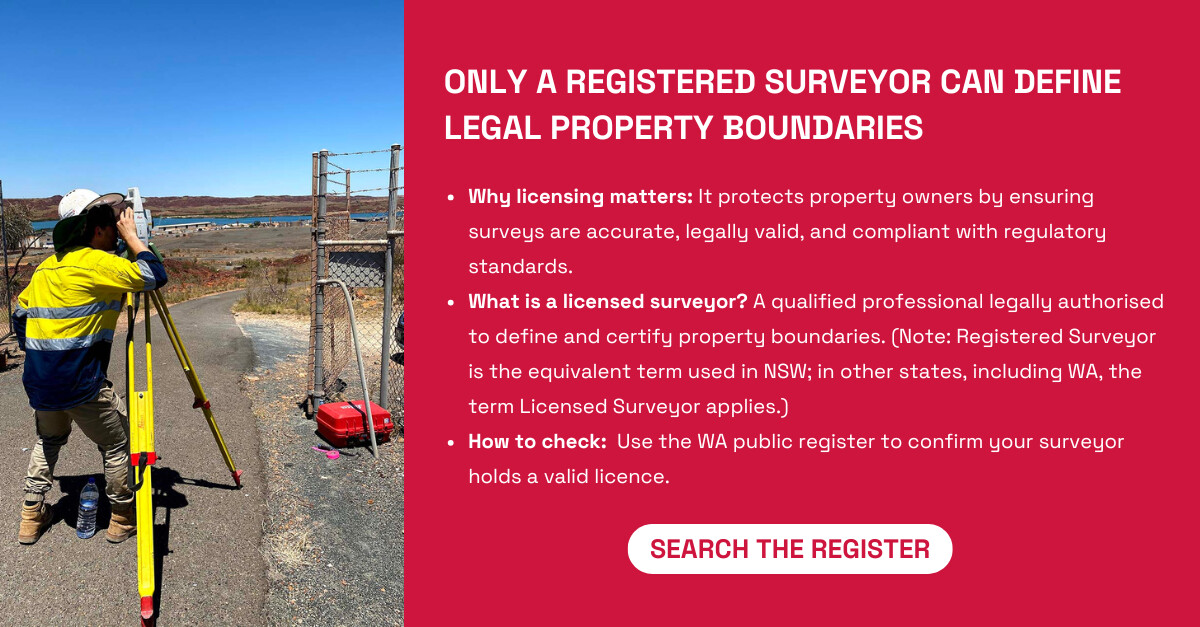
The WA Land Surveyors Licensing Board (LSLB) has announced its third successful prosecution involving unregistered surveyors, reinforcing the importance of licensing across the profession. Licensing ensures that only qualified professionals are legally authorised to define property boundaries. The recent case adds to a broader regulatory push seen in other states, including New South Wales, where authorities are increasing enforcement to uphold industry standards. As scrutiny intensifies nationwide, licensing remains a critical safeguard for ensuring accuracy, compliance, and public trust in land surveying.
The requirement for registration isn’t just a legal formality — it’s a foundation for quality. Clients and communities rely on accurate boundary information. Work carried out by a Licensed Surveyor gives them assurance that work is carried out to professional and technical standards.
- Bennett Tunbridge, Licensed Surveyor and General Manager of Operations at RM Surveys
In November 2024, the LSLB successfully prosecuted an individual for conducting authorised surveys while unlicensed. The surveyor, who had never been a licensed surveyor, pled guilty in the Perth Magistrates Court to six criminal charges.
The Court found that even without lodging a survey, physically marking property boundaries could mislead clients, builders, and the public — making the work unlawful. The individual was fined and ordered to contribute to the Board’s legal costs. This marks the third successful prosecution of unregistered surveyors in WA, reinforcing the Board’s commitment to protecting professional standards and public confidence in the industry.
What this means for your project:
- You may be exposed to compliance risk if using unregistered surveyors
- Project approvals could be delayed or rejected
- Survey data may not meet regulatory standards
- Liability may sit with the project owner or contractor
Why licensing matters in surveying
Engaging a Licensed Surveyor isn’t just a regulatory requirement — it’s a safeguard against risk. Unregistered surveyors lack the qualifications and know how needed to ensure property boundaries are defined accurately and legally. Errors in boundary marking can lead to costly disputes, delays in approvals, and complications in property transactions.
Licensing ensures that surveyors meet established technical standards, operate under a code of conduct, and are accountable to a governing body. It also gives clients confidence that the work they receive is both reliable and compliant.
“In cadastral and engineering surveying, there is no margin for error,” says Tunbridge.
“Without proper qualifications and supervision, errors can be made — with significant downstream consequences for everyone involved in a project.”
Why WA is increasing enforcement
WA’s increased enforcement is not just a regulatory response — it reflects broader changes in how projects are delivered and governed.
This shift reflects:
- Increased project complexity
- Higher regulatory scrutiny
- Greater reliance on accurate spatial data
As projects become more data-driven, survey information is being relied on earlier and more heavily across design, approvals, and construction.
This increases the consequences of errors, inconsistencies, or non-compliant work.
Regulators are responding by placing greater emphasis on accountability, ensuring that survey work tied to legal boundaries, land ownership, and approvals is carried out by appropriately registered professionals.
For project teams, this means compliance is no longer just a box to tick — it is a critical part of managing risk, maintaining programme certainty, and avoiding costly rework.
Beyond compliance: the role of survey data in modern projects
This shift is not only about registration and compliance — it reflects how survey data is now used across projects.
Survey data is increasingly expected to be:
- Verified and traceable
- Structured for integration into digital engineering workflows and geospatial systems
- Reliable enough to support critical decisions
As a result, the impact of poor-quality or non-compliant data is wider than before. It can affect design coordination, approvals, and construction outcomes.
In this context, compliance is closely linked to data integrity – and both are essential to maintaining confidence across the project lifecycle.
Licensing enforcement beyond WA
Western Australia is not alone in addressing the issue of unregistered surveyors. In New South Wales, the Board of Surveying and Spatial Information (BOSSI) has increased enforcement activity, pursuing legal action against individuals operating without registration. These actions reflect a wider national trend toward strengthening compliance and protecting the integrity of the profession.
At RM Surveys, we’re aligned with this direction and support efforts to ensure only qualified, licensed professionals carry out surveying work. Maintaining high standards across the industry benefits clients, communities, and long-term trust in the profession.
“There’s strong momentum now to lift the bar nationally — not just for cadastral licensing, but for engineering certification too,” says Tunbridge, who recently spoke at a national event on engineering surveyor standards.
“Being part of those conversations helps us contribute to the future of the profession, not just react to it.”
How RM Surveys supports compliance and confidence
RM Surveys, along with a growing coalition of surveying companies, stands firmly behind efforts to maintain high professional standards. As advocates for quality and compliance, we support ongoing enforcement of registration requirements and broader professional development initiatives like the National Engineering Surveyors Certification (NESC).
This commitment to professionalism is embedded in how we operate. All RM Surveys field and office staff involved in survey delivery are fully qualified and registered where required. Our work is supported by structured QA processes, ongoing technical training, and a culture that prioritises accountability and precision.
We regularly deliver projects across construction, infrastructure, mining, and cadastral sectors – where the need for accuracy, clarity, and compliance is critical. Our internal systems are designed to meet these demands consistently, giving clients confidence that every project is approached with the highest level of care and capability.
If you’re planning a project or reviewing your current survey approach, speak with RM Surveys to ensure your data meets both regulatory requirements and the demands of modern project delivery.
Frequently asked questions
What is a registered surveyor in Western Australia?
A registered surveyor is a professional accredited under WA legislation to perform cadastral and legal survey work. This includes boundary definition, subdivision, and surveys used for statutory approvals.
Only registered surveyors can legally undertake certain types of work, particularly where land ownership, boundaries, or titles are involved.
Can I use an unregistered surveyor?
For some engineering or construction surveys, yes. But for cadastral or legal surveys, a registered surveyor is required.
What happens if I use an unregistered provider?
You may face compliance issues, rejected submissions, or the need to redo work.
Who is responsible for compliance?
Ultimately, the asset owner or project lead carries the risk.
Need help with a boundary survey or compliance question?
Our licensed surveyors are here to help.
Contact RM Surveys