
Why Automatic Deformation Monitoring Systems Are Becoming Essential
There’s a version of structural monitoring that most project teams are familiar with: a surveyor visits the site on a schedule, takes measurements, writes a report, and files it. The structure is declared stable, and construction continues.
The problem is what happens between visits.
On complex urban builds, major infrastructure projects, and deep excavations, conditions don’t wait for the next scheduled survey. Variables like ground movement and structural stress develop continuously. And that means, by the time a periodic report captures an anomaly, the window to safely respond to it may have already closed.
This is precisely why automatic deformation monitoring systems (ADMS) are becoming a standard expectation on projects where the consequences of delayed data are too significant to accept. It’s not about technology for its own sake. It’s about the gap between what traditional monitoring can tell you and what modern project environments actually require.
Key takeaways
- Modern construction projects operate in increasingly complex risk environments. Urban density, adjacent assets, and sensitive infrastructure demand more than periodic check-ins.
- Traditional, manual monitoring approaches create sizable gaps between measurement and response.
- An automatic deformation monitoring system records continuous, real-time movements data across an entire site, and feeds it directly into project decision-making.
- The real value isn’t just the data. It’s the ability to act before thresholds are exceeded, protect neighbouring structures, and maintain compliance without disruption.
- RM Surveys approaches monitoring as a lifecycle discipline, not a construction-phase afterthought.
Why construction risk has outgrown traditional monitoring
Risk environments are becoming more demanding
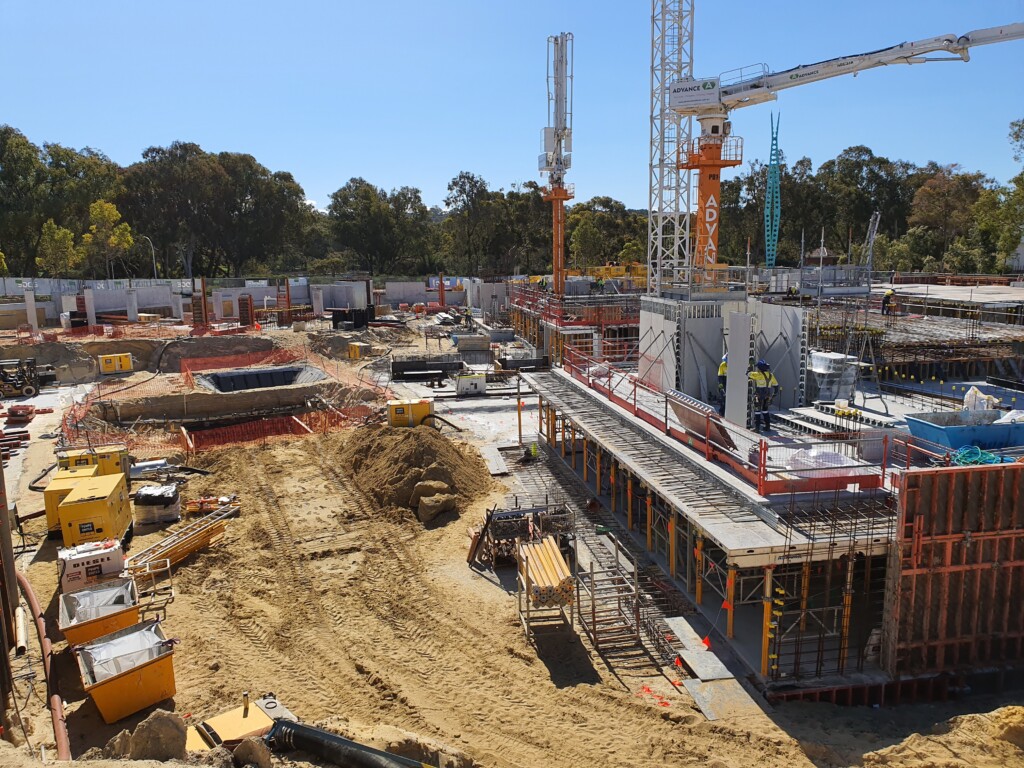
Urban construction is operating in tighter constraints than ever before. Multi-storey developments are rising up beside heritage buildings, active transit corridors, and operating utilities. Excavations are going deeper into ground conditions that are increasingly well-documented but still unpredictable in practice.
The consequence of structural movement in these environments isn’t just project delay. It’s damage to third-party assets, liability exposure, and, in the worst cases, safety incidents that carry long-term reputational and legal consequences.
At the same time, regulatory frameworks governing work health and safety across Australian construction continue to evolve. Contractors and asset owners carry clear duty of care obligations not just for their own workers, but for adjacent property and the broader public. Meeting those obligations requires more than a periodic paper trail. It necessitates demonstrable, real-time evidence that risk is being actively managed. Australia’s model WHS Act underpins these obligations across more jurisdictions, and expectations around monitoring and documented safety management are increasingly central to compliance.
Stakeholders expect early warning, not retrospective reporting
Project owners, financiers, and regulators have become less tolerant of reactive workflows. The expectation has shifted from documenting what happened to demonstrating that risks were identified and managed before they escalated.
An automatic deformation monitoring system is one of the clearest ways to meet that expectation. When movement data is consistent and threshold alerts are configured in advance, there’s an auditable record of how the site was managed, and a defensible basis for every decision made.
What manual monitoring misses
Scheduled surveys have their place. For low-risk structures in stable conditions, periodic survey data may be entirely appropriate. But on complex projects, it carries consistent weaknesses, including the following:
- It offers a snapshot, not a signal. A manual survey captures site conditions at a single point in time. Structural movement that develops and partially recovers between visits may never appear in the record at all.
- The lag creates vulnerability. There’s an inevitable delay between when a measurement is taken, when a report is written, and when a project team can act on the findings. During fast-moving construction projects, that lag is a structural vulnerability in itself.
- Monitoring is often installed too late. On many projects, monitoring systems are only commissioned once construction is well underway, after the window for establishing an accurate pre-construction baseline has already closed. Without that, it’s significantly harder to determine normal variation from genuine cause for concern.
- Systems aren’t always matched to a project’s risk level. A generic monitoring approach applied to a project with specific geotechnical challenges, nearby heritage structures, or restricted access zones will consistently miss the signals that matter most.
These issues aren’t failures of the people involved. Instead, they’re limitations of the methodology. An automatic deformation monitoring system addresses each of them directly.
What an automatic deformation monitoring system actually is
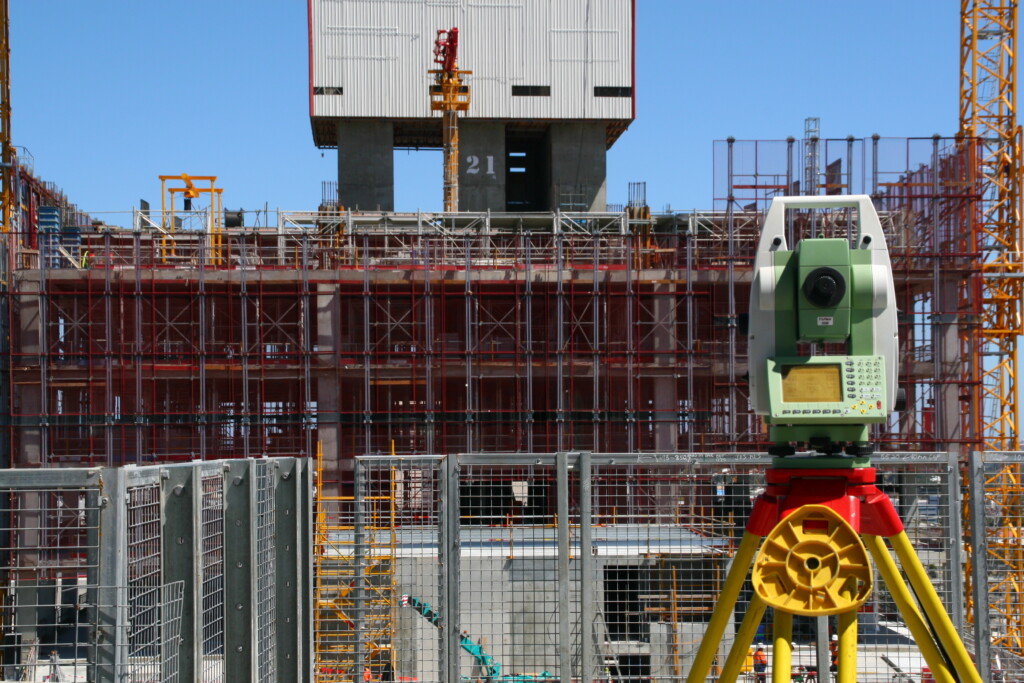
An automatic deformation monitoring system is a network of integrated sensors and telemetry infrastructure designed to capture structural movement data continually. As data is collected, it processes it automatically, and delivers it to project teams through a centralised platform.
In practice, a system typically combines several sensor types depending on the specific monitoring requirements of the project. That includes:
- Robotic total stations (ATS) for high-precision angular and distance measurement prisms mounted on structures or ground anchors.
- GNSS receivers for continuous three-dimensional position tracking across larger areas or open sites.
- Tilt sensors and inclinometers for monitoring rotational movement in retaining walls, piles, or slopes.
- Crack meters and joint sensors for tracking the opening or closing of specific structural discontinuities.
- Settlement sensors and piezometers for measuring vertical displacement and pore water pressure in soil or fill.
These sensors communicate via telemetry networks, often LoRaWAN or IoT-based protocols, to feed raw measurements into a processing engine that applies alert thresholds in real time. When movement exceeds a defined limit, the system notifies the relevant people immediately rather than waiting for the next report.
The automated data capture also removes one of the more significant risks in traditional monitoring. That is the need for surveyors to physically enter highly volatile zones, like unstable slopes or confined spaces, for routine measurement. Remote collection keeps people away from hazardous environments while maintaining continuous data quality.
The real value: Decision-making, not just data collection
An automatic deformation monitoring system produces a large volume of data, but that’s not the value proposition.
The value is what this data enables. When movement trends are visible in real time, project teams can differentiate between expected elastic deformation—the kind that resolves itself as the local conditions change—and progressive settlement or displacement that signals a genuine threshold being approached.
That distinction is critical. It allows teams to act before a limit is reached, rather than after it’s been exceeded. Construction activities can be paused, load conditions adjusted, or remedial works initiated while the window to intervene is safely still open. For adjacent assets, from active rail corridors to a neighbour’s foundation, around-the-clock monitoring is often the only way to demonstrate that obligations are being met in real time.
There’s also an efficiency dimension to automatic deformation monitoring systems that’s often overlooked. When monitoring data is continuous and accessible, teams often spend less time commissioning emergency surveys after unexpected events and more time making planned, evidence-based decisions. The cost of the monitoring system is frequently offset by the reduction in reactive works, insurance claims, and programme disruption.
Integration with digital project environments
Monitoring data has traditionally lived in isolation. It’s collected in the field, reported in a document, and filed in a project archive. That model doesn’t reflect how modern project environments actually operate.
Digital twins and Building Information Modelling (BIM) workflows depend on live, reliable data to remain useful throughout construction. When a monitoring feed from an automatic deformation monitoring system is connected directly with these environments, displacement data becomes a dynamic input to the project model rather than a static point-in-time snapshot.
Centralised cloud-based dashboards extend that further. Stakeholders can view live displacement data, review historical trends, and receive automated alerts without being physically present on site. That shared visibility supports better-informed decisions and gives each stakeholder a consistent, auditable source of truth.
For compliance-intensive projects, this integration also simplifies reporting. Displacement information can be linked directly to construction programme milestones, making it straightforward to show that monitoring obligations were met at each stage and that any exceedances were responded to appropriately. Research from the University of Melbourne’s Digital Twin Platform for Structural Health Monitoring underscores the growing application of these integrated approaches across Australian infrastructure projects.
Common gaps that undermine monitoring outcomes
The case for ADMS is clear, but the system is only as effective as its implementation. Even well-intentioned monitoring programmes fall short when the setup isn’t matched to the project. The most common gaps include the following:
- Late mobilisation. A monitoring system has limited value without an accurate picture of conditions before work began. When systems are commissioned mid-project, that baseline doesn’t exist. Readings still come in, but there’s no reliable foundation to measure them against.
- Misaligned sensor placement. Sensors positioned to satisfy a general monitoring requirement, rather than the specific geotechnical or structural vulnerabilities of the site, will collect data that doesn’t answer the questions that matter. Effective ADMS design requires an understanding of where movement is most likely to occur, and what type of movement is most consequential.
- Data that isn’t structured for use. Raw sensor output isn’t decision-ready. Without appropriate processing, visualisation, and threshold configuration, a continuous data stream can become overwhelming rather than useful. Monitoring data needs to be structured so that the correct people receive the right signals at the right time.
- Over-reliance on manual interpretation between automated alerts. Automated alerting is essential, but it shouldn’t be the only lens through which monitoring data is reviewed. Trend analysis—in other words, looking at how movement is progressing, not just whether it’s exceeded a threshold—often provides earlier, more nuanced signals of developing risk.
From baseline to handover: The RM Surveys approach
At RM Surveys, monitoring isn’t treated as a construction-phase compliance task. It’s a discipline that should be active across the complete asset lifecycle, and the value of getting that right compounds at each stage.
Pre-construction: Establishing the baseline
The most important monitoring decision on any project is often made before a single sod is turned. Installing sensors and capturing a thorough pre-construction baseline of the subject, assets close in proximity, and surrounding ground conditions, gives every subsequent reading context. A dilapidation survey of neighbouring structures at this stage provides an additional layer of protection for all parties.
Commissioning monitoring early also allows the system to be calibrated to the specific risk profile of the project rather than a generic industry standard.
During construction: Active risk management
A well-designed automatic deformation monitoring system moves passive data collection to active risk management as construction is underway. Real-time displacement data informs sequencing, supports safe excavation management, and provides the documentation trail required by stakeholders and regulatory bodies.
Our construction and engineering surveying teams work in close coordination with monitoring systems. As a result, they integrate spatial data into the broader project environment and ensure that alerts translate into clear, actionable decisions on the ground.
Post-construction: Long-term asset performance
The end of a project doesn’t mean the conclusion of monitoring obligations. Structures continue to settle and respond to load changes, seasonal variation, and adjacent works. For infrastructure assets with long operational lives, transitioning monitoring data into an ongoing performance management framework extends the value of the investment made during construction.
This is the lifecycle perspective that distinguishes a thoughtful monitoring strategy from a compliance checkbox.
Ready to design a monitoring system for your project?
Every project has a different risk profile. Effective monitoring starts with a clear read of the site, including the vulnerabilities present, the assets at stake, and what protection looks like at each stage.
RM Surveys works with project teams from planning through to handover, designing monitoring strategies that are genuinely aligned to project risk—not just compliant with minimum requirements.
Talk to our team early in your planning phase, and we’ll help you build a monitoring approach that protects your project, your stakeholders, and the assets around you.
FAQs
What's the difference between a deformation monitoring survey and an automatic deformation monitoring system?
A deformation monitoring survey is typically a periodic, manual process in which a surveyor visits the site, takes measurements, and produces a report. An automatic deformation monitoring system captures the same type of data continuously, using a network of sensors that communicate in real time without requiring regular site visits. The key difference is the time lag. A periodic survey can only tell you what conditions were at the point of measurement, while an ADMS tells you what’s happening right now.
How do I know if my project needs an automatic deformation monitoring system?
Projects that typically benefit from ADMS include those involving deep excavations near existing structures, works adjacent to long-standing assets, active rail or transit corridors, or sensitive ground conditions such as soft clays or undermined ground. Regulatory requirements, contract obligations, and the proximity of third-party assets are all factors that should be assessed early in the project planning phase, ideally before design is finalised.
When should monitoring be set up on a construction project?
As early as possible. Installing sensors and capturing a pre-construction baseline before works begin is one of the most important steps in effective monitoring. Without that baseline, it’s difficult to distinguish normal background movement from construction-induced displacement. On projects where adjacent asset protection is a key concern, early mobilisation also supports the dilapidation survey process by providing spatial context for existing conditions.
Can monitoring data be integrated with BIM or project management platforms?
Yes. Continuous monitoring data can feed directly into BIM environments, digital twins, and cloud-based project dashboards. This integration allows displacement data to be viewed in the context of design intent, construction programme, and structural analysis models, giving project teams a much richer picture than standalone monitoring reports provide. RM Surveys has experience delivering geospatial and digital services that integrate monitoring data into broader digital project environments.
What happens when a monitoring alert is triggered?
Alert thresholds are configured during system setup, typically in consultation with the structural or geotechnical engineer of record. When a sensor reading exceeds a defined limit, an automated notification is sent to the relevant team members. The appropriate response depends on the project-specific monitoring plan, but typically involves a review of the data, a site assessment, and a decision on whether construction activities should be modified or paused. The key advantage of automated alerting is that this process begins immediately, not at the next scheduled reporting interval.
Need help with a Automatic Deformation Monitoring Systems or compliance question?
Our licensed surveyors are here to help.
Contact RM Surveys