
Subdivision in WA: How to Subdivide Your Land
Subdividing land in Western Australia can create opportunities for property development, investment or the sale of individual lots. However, the process involves more than dividing a property into smaller parcels. Before new titles can be issued, a subdivision must satisfy planning requirements, obtain the necessary approvals and complete any required infrastructure works.
Whether you’re considering a two-lot residential subdivision or a larger development, understanding the process can help you assess feasibility, anticipate costs and plan your project.
Key takeaways
- Subdivision in WA generally involves five main stages: feasibility, planning approval, subdivision works, clearances and registration of new titles.
- A property having sufficient land area doesn’t automatically mean it can be subdivided. Zoning, planning controls, access and servicing requirements must also be considered.
- Conditional subdivision approval from the Western Australian Planning Commission (WAPC) is an important milestone, but additional work is usually required before new titles can be issued.
- Subdivision costs and timeframes depend on the property, proposed development, infrastructure requirements and approval conditions.
- Surveying supports subdivision throughout the process, from understanding existing site conditions to establishing new lot boundaries and preparing survey documentation.
What is land subdivision?
Subdivision is the process of dividing an existing parcel of land into two or more lots.
In Western Australia, two common forms are green title subdivision and survey-strata subdivision.
Green title subdivision creates separately titled lots, generally without shared ownership of common property.
Survey-strata subdivision creates individually titled lots within a strata scheme, which may include common property or shared infrastructure.
The appropriate subdivision type depends on the property’s characteristics, planning requirements and intended development.
How to subdivide land in WA
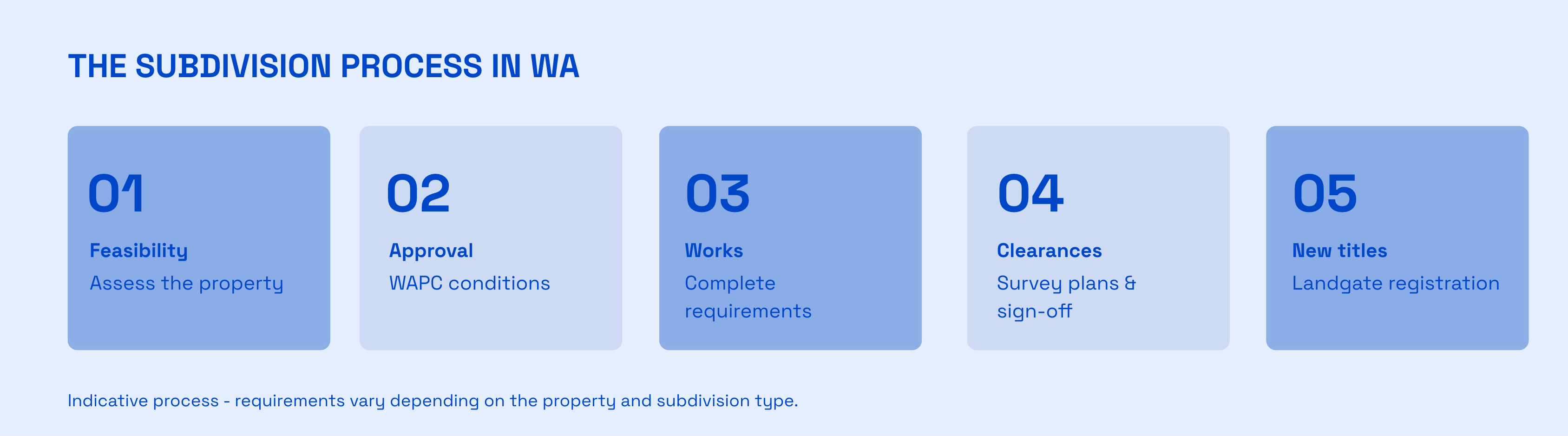
Although every project is different, the subdivision process generally involves five stages.
1. Assess subdivision feasibility
The first step is determining whether the proposed subdivision is achievable.
This involves reviewing zoning, lot size, planning controls, easements, access, existing structures and infrastructure requirements. A feature and contour survey provides accurate information about the property’s physical characteristics, supporting the initial subdivision design.
These investigations help identify constraints before significant resources are committed to the project.
2. Prepare the design and obtain planning approval
Once feasibility has been established, a subdivision design is prepared in accordance with the relevant planning requirements.
Most subdivision applications in WA are assessed by the Western Australian Planning Commission (WAPC). The WAPC subdivision application guidelines explain the application process, documentation and relevant requirements. The WAPC may issue conditional approval, outlining requirements that must be satisfied before the subdivision can progress.
These conditions can relate to access, drainage, utility connections, infrastructure upgrades and other site-specific matters. Conditional approval doesn’t mean the subdivision is complete. It establishes the requirements for progressing towards final clearance.
3. Complete subdivision works
Subdivision works involve satisfying the conditions attached to planning approval.Depending on the property, these may include earthworks, drainage, retaining walls, utility connections, crossovers, fencing, demolition or infrastructure upgrades.
Some subdivisions require relatively limited physical works, while others involve multiple contractors, consultants and service providers.Understanding these requirements early is important because they can represent a significant proportion of the overall subdivision cost.
4. Obtain clearances and complete survey documentation
Once the relevant conditions have been satisfied, evidence of completion is submitted to the responsible authorities.These may include local government, Western Power, Water Corporation and other agencies identified in the subdivision approval.A licensed surveyor also undertakes the necessary cadastral surveying and prepares subdivision plan documentation.The requirements differ depending on the type of subdivision and the conditions imposed.
5. Register the subdivision and obtain new titles
The final stage involves completing the registration requirements through Landgate.Additional documentation may be required, including notifications, restrictive covenants, survey-strata documents or consent from relevant parties.
Landgate provides detailed information about applications for new titles following subdivision. Once registration is complete, new titles can be issued for the subdivided lots.
How much does subdivision cost in WA?
Subdivision costs vary depending on the property, proposed number of lots, subdivision type and conditions imposed during planning approval.Common expenses include planning applications, surveying, engineering, infrastructure connections, earthworks, drainage, construction and registration.
For example, two properties with similar lot sizes may have very different subdivision costs if one requires substantial retaining walls, drainage upgrades or relocation of existing services.
A feasibility assessment can help identify these requirements before committing to the subdivision.
How long does subdivision take in WA?
Subdivision timeframes depend on the complexity of the proposal, planning assessment, infrastructure requirements, authority clearances and registration.
Some activities can proceed concurrently, while others depend on earlier approvals or completed works.
For this reason, the overall timeframe should be assessed against the specific property rather than relying on a single standard estimate.
Where does surveying fit into the subdivision process?
Surveying contributes to several stages of subdivision.
Early feature and contour surveys provide information about existing site conditions, allowing planners and designers to understand the property and develop suitable subdivision layouts. Boundary re-establishment may also be necessary to verify existing legal boundaries, particularly where proposed lot configurations or construction works depend on their position.
As the project progresses, cadastral surveying establishes the new lot boundaries and supports the preparation of subdivision plans and associated documentation. Accurate survey information helps reduce uncertainty during design, supports coordination between consultants and provides the spatial foundation for creating new lots.
Subdivision surveying with RM Surveys
RM Surveys provides property development surveying services for property owners, developers and project teams across Western Australia. Our cadastral team supports subdivision projects through feature and contour surveys, boundary re-establishment, cadastral surveying and subdivision plan preparation.
With access to RM Surveys’ broader Cadastral & Property capabilities, we can also support projects requiring additional spatial information during planning, design and development.
FAQ's
Can I subdivide my property in WA?
Whether a property can be subdivided depends on its zoning, lot size, planning controls, access, servicing requirements and other site-specific constraints. A feasibility assessment is the best starting point for understanding what may be possible.
Do I need a surveyor to subdivide land?
Licensed surveying services are required for cadastral survey work and the preparation of relevant subdivision survey documentation. Surveying may also be needed earlier to support feasibility assessments, subdivision design and boundary verification.
What's the difference between green title and survey-strata subdivision?
Green title subdivision generally creates separate lots without shared common property. Survey-strata subdivision creates lots within a strata scheme, which may include common property or shared infrastructure.
How much does a two-lot subdivision cost in WA?
The cost depends on the property’s characteristics, servicing arrangements, approval conditions and required works. A two-lot subdivision involving substantial infrastructure upgrades may cost significantly more than one with straightforward access and servicing.
Does subdivision approval mean I can sell the new lots?
Conditional planning approval doesn’t create new titles. The relevant approval conditions, clearances, surveying and registration requirements must be completed before the new titles can be issued.
Considering a subdivision?
Understanding your property’s boundaries, physical characteristics and planning constraints early can help you make informed decisions about a proposed subdivision.
RM Surveys’ cadastral team can assist with the surveying requirements for subdivision projects across Western Australia.
Contact RM Surveys to discuss your subdivision surveying requirements.